
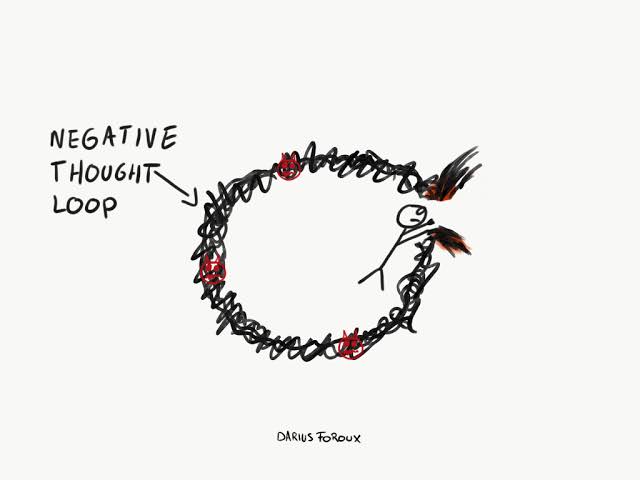
It’s 2am. You’re staring at the ceiling, and your brain has opened the same file it opens every night — the text you weren’t supposed to see, the tone of voice you can’t stop hearing, the moment you realized you already knew. You’ve watched this scene a thousand times. It never ends differently.
This isn’t weakness, and it isn’t you “not being over it yet.” It’s a specific, well-documented pattern the brain runs after betrayal — and once you understand what it’s actually doing, you can interrupt it. Not suppress it. Interrupt it.
The replay loop exists because your brain is trying to solve a problem it thinks is still solvable: “If I go over this enough times, I’ll finally understand it — and once I understand it, I’ll be safe from it happening again.” That’s the trap. The scene doesn’t change. The understanding never arrives. But the search never calls itself off, because as far as your nervous system is concerned, the case is still open.
Why “just stop thinking about it” never works
Telling yourself to stop is treating this like a willpower problem. It isn’t. The loop is your threat-detection system doing its job — badly, at 2am, on a memory that can’t actually hurt you anymore, but that your body hasn’t gotten the memo on. Fighting it directly just proves to your nervous system that the threat is still active, which keeps the loop running longer.
“You don’t stop the replay by out-arguing it. You stop it by giving your nervous system proof the search is over.”
The technique that actually works is what I call closing the file — a short, physical, repeatable action that tells your body “this has been logged, you can stand down” instead of trying to win the argument in your head. It takes under two minutes, and it works precisely because it doesn’t ask you to think your way out of a thinking problem.
The three-step interrupt
1. Name it out loud, once. Not the whole story — just the fact. “I’m replaying the text again.” Saying it breaks the loop’s illusion that it’s happening to you rather than being run by you.
2. Change your physical position. Sit up, stand, put your feet flat on the floor. The loop runs on stillness. Movement — even small — tells your nervous system the “danger scan” can end.
3. Redirect to one concrete, unrelated task. Not a distraction — a task. Fold one thing. Write one line. Answer one email you’ve been avoiding. The goal isn’t to forget; it’s to prove to your brain that the present moment has something in it besides the file.
This won’t make the memory disappear. That’s not the goal, and anyone promising you that is selling something. The goal is a loop that runs for ninety seconds instead of ninety minutes — and eventually, weeks from now, barely runs at all.